Neurons communicate through spikes
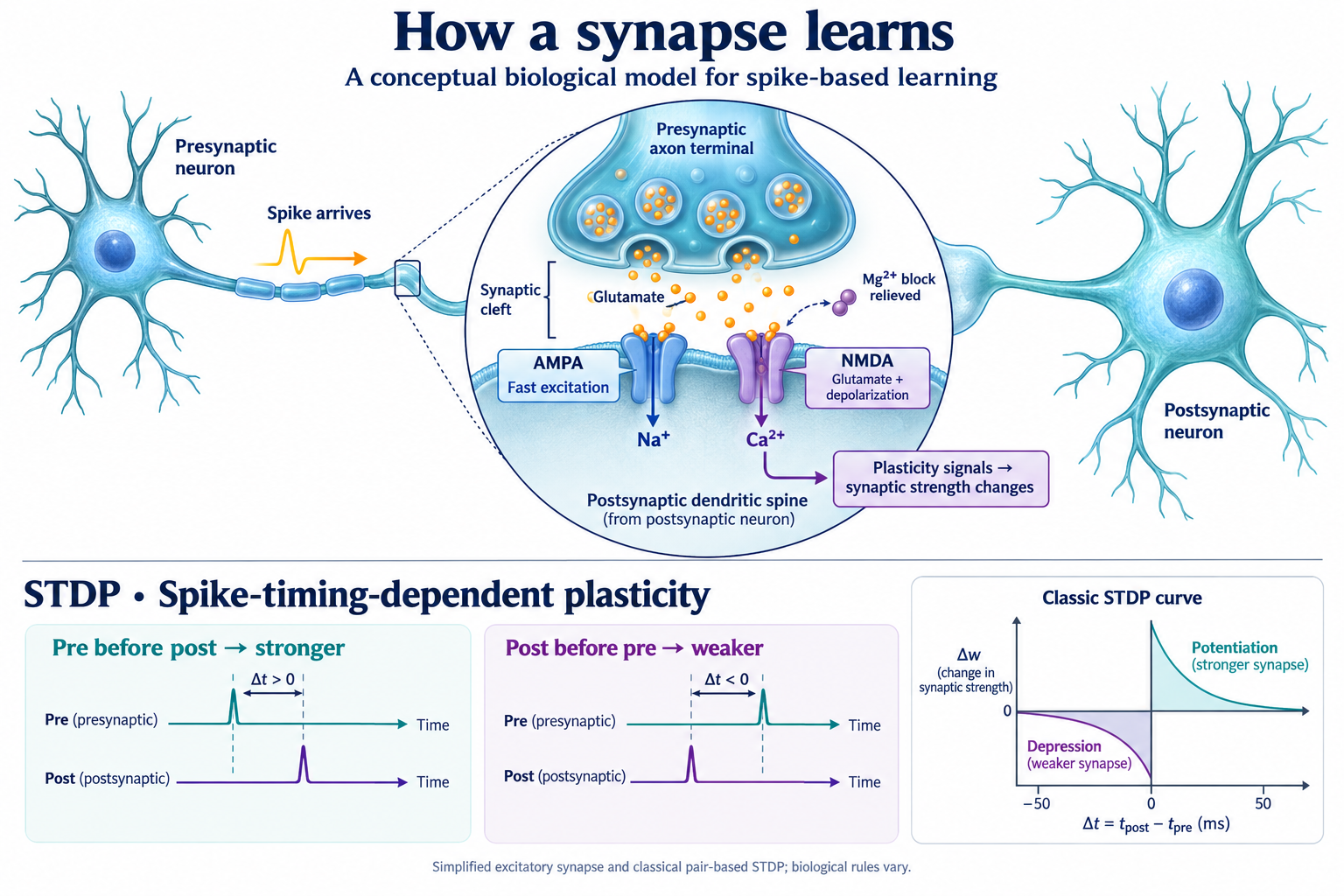
A spike is a brief electrical event. When it reaches a presynaptic terminal, it can trigger the release of glutamate into the synaptic cleft.
THE FUNDAMENTAL PRINCIPLE
The biological synapse is the inspiration behind ThalaMoss Pulse’s learning principle: connections that change with activity.
ThalaMoss Pulse is designed to learn recurring patterns from sensor signals without requiring pre-training or predefined labels. Synapse-inspired learning puts the focus on the connections between neurons and the timing of their spikes.
FROM SIGNAL TO CHANGE
A spike is a brief electrical event. When it reaches a presynaptic terminal, it can trigger the release of glutamate into the synaptic cleft.
Glutamate activates receptors on the receiving neuron. AMPA receptors provide fast excitation. NMDA receptors link glutamate binding with postsynaptic depolarization: relief of the magnesium block allows calcium to enter and contribute to plasticity signals.
In classical pair-based STDP, a presynaptic spike shortly before a postsynaptic spike tends to strengthen the connection. Reversing the order tends to weaken it. STDP means spike-timing-dependent plasticity; the rules vary across biological synapses.
THE ENGINE’S INSPIRATION
The central idea is to make the synapse an active part of learning. The timing of activity provides a local basis for changing a connection, offering a biological inspiration for learning recurring patterns from signals.
The diagram explains the biological principle. Glutamate, AMPA/NMDA receptors, and calcium are shown as biological mechanisms; this illustration does not specify how each is represented in the software.
Explore ThalaMoss Pulse